Is that “package delivery fee” text a scam?
Short answer: yes. A text saying USPS, FedEx, UPS, or another carrier could not deliver your package because of a small unpaid fee or an incomplete address is one of the most common scams in the country, especially around holidays. Carriers do not text you a link asking for card details to release a package.
What does a fake package-delivery-fee text look like?
You get a text claiming to be from USPS or another delivery service: your package could not be delivered because of an “unpaid customs fee,” a “redelivery fee,” or an “incomplete address” that needs to be confirmed. It includes a tracking-style number and a link to “schedule redelivery” or “update your address.” Following the link leads to a page asking for your name, address, and card details to pay a small fee, often just a few dollars.
Because so many people are genuinely expecting a package at any given time, the message feels timely and believable, especially if you shop online often.
Why does the package-delivery text scam work?
The scam exploits how normal package delivery already feels: tracking numbers, delivery attempts, and small service fees are all things people have seen from real carriers before. A tiny dollar amount feels too small to be worth questioning, so people pay it just to make a possible problem go away rather than verify it. Once your card details are entered, the scammer has what they need to make further unauthorized charges or sell your information.
By the numbers: fake package-delivery messages, usually impersonating USPS, were the single most-reported text scam in the FTC's Consumer Sentinel Network in 2024, part of the $470 million people reported losing to text scams that year. Source: FTC Data Spotlight, "Top text scams of 2024".
Red flags to watch for
- A text (not an email from the carrier's real notification system, and not an alert inside the carrier's own app) about a delivery problem.
- A link with a domain that does not match usps.com, fedex.com, or ups.com, often ending in unrelated extensions like “.info,” “.top,” or containing extra words like “usps-redelivery.com.”
- A request for a small payment (often under $5) to release or redeliver a package.
- A request for your full name, address, and card number on a page reached only through a text link.
- You are not actually expecting a package, or the tracking number does not match anything you ordered.
What should I do if I get a package-delivery-fee text?
- Do not tap the link. Do not enter any payment or personal information.
- Delete the text, or report it as junk in your phone's messaging app.
- To check a real package, go directly to the carrier's official website or app and enter the tracking number yourself, never through a link from a text.
- If you already entered card details, call your card issuer immediately (the number on the back of your card) to report possible fraud.
- Not sure? Screenshot the text and send it in for a second opinion before you tap anything.
Got a delivery text you are not sure about? Start a free trial and send us a screenshot. Our AI checks the message and emails you back what to do about it, and what it found.
Start your free trialSee an example
This is illustrative, not a subscriber submission: we ran a message written to match this scam's real-world pattern through our current system, and these are real excerpts from that check, cropped to the parts that matter, not the full text. For a real reply we actually sent, under our earlier format, switch to the other tab.
Subject: USPS: Redelivery Fee Due - Package #4471
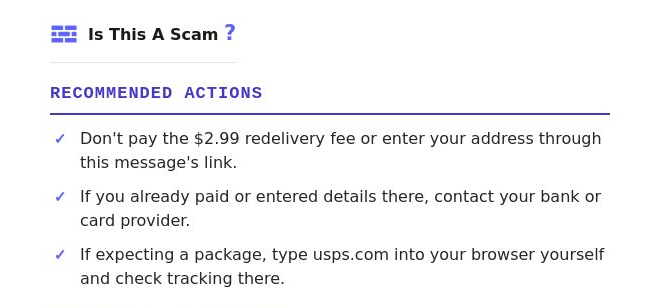

This is the reply we actually sent, quoted as it went out. It was assessed under our earlier verdict format, so it opens with a verdict word. Reports now open with the recommended actions and name what we found beneath them, with no verdict word. We never rewrite an assessment we have already delivered.
Verdict: SCAM
A user received a text claiming a package could not be delivered because of an incomplete address, with a link to “confirm your details” for a small fee. The link led to a page requesting a full name, address, and card number.
The domain in the link had no connection to any real carrier, and the request for card details to “confirm an address” is not something legitimate delivery services do. This matches the standard package-redelivery scam pattern seen across USPS, FedEx, and UPS impersonation reports.
Verify through official channels
- Report text scams impersonating USPS to the US Postal Inspection Service at uspis.gov.
- Report the message to the US Federal Trade Commission at reportfraud.ftc.gov.
- Forward spam texts to 7726 (SPAM) to alert your mobile carrier.
- Check a real package's status only by typing the tracking number into the carrier's official site yourself.