Is that “grandchild in trouble” call real?
Short answer: almost certainly not, even if the voice on the phone sounds exactly like your grandchild or another family member. This is the classic “grandparent scam,” and it has gotten harder to spot because AI voice-cloning tools can now recreate a familiar voice from a few seconds of audio taken from a video posted online.
What does a fake grandchild-in-trouble call sound like?
A call comes in, often late at night, and the voice sounds like a grandchild, in tears or distress: “Grandma, I'm in trouble, please don't tell Mom and Dad.” A second person then gets on the line claiming to be a lawyer, bail bondsman, or police officer, explaining that the “grandchild” was in a car accident, arrested, or in trouble in another country, and needs money right now for bail, medical bills, or a fine, usually by wire transfer, gift cards, or handing cash to a courier.
The caller insists on secrecy (“don't call my parents, I'm so embarrassed”) and urgency (“I need this in the next hour”), which is designed to stop you from pausing to verify anything with the rest of the family.
Why does the grandparent emergency-call scam work?
This scam is built entirely around isolating an emotional decision from a rational one. The request for secrecy cuts off the easiest way to check the story: calling another family member. The urgency stops you from calling the grandchild back on their known number. And a cloned or simply similar-sounding voice, combined with your own instinct to fill in details (“that does sound like him”), can override healthy skepticism in the first shocked moments of the call.
By the numbers: the FTC's own data on family-and-friend impostor scams found people 70 and older who mailed cash reported a median loss of $9,000, and that the caller posed as a grandchild, usually a grandson, about seven times in ten. Source: FTC Data Spotlight, "New twist to grandparent scam: mail cash".
Red flags to watch for
- A request to keep the situation secret from other family members.
- Pressure to send money immediately, especially by wire transfer, gift cards, or a cash courier, none of which is traceable or reversible.
- A second caller claiming to be a lawyer, bail bondsman, or officer who conveniently handles the payment instructions.
- The call comes from an unfamiliar number, even if caller ID shows a name you recognize, because caller ID can be faked.
- Money is requested before you have independently reached the family member in question.
What should I do if I get a call about a grandchild in trouble?
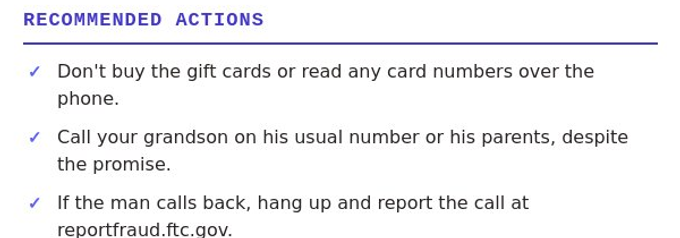
- Hang up, then call the grandchild or family member directly on the number you already have for them, not a number the caller gives you.
- If you cannot reach them, call another family member to check the story before doing anything else.
- Agree on a family “safe word” in advance that a real emergency call would include and a scammer would not know.
- Never wire money, buy gift cards, or hand cash to a courier based on a phone call alone, no matter how urgent it sounds or how familiar the voice is.
- Not sure? If you have a voicemail or can describe the call, send it in for a second opinion before sending anything.
Got a family-emergency call you are not sure about? Start a free trial, then describe it or attach the voicemail. Our AI checks it and emails you back what to do about it, and what it found.
Start your free trialSee an example
This is illustrative, not a subscriber submission: we ran a message written to match this scam's real-world pattern through our current system, and these are real excerpts from that check, cropped to the parts that matter, not the full text. For a real reply we actually sent, under our earlier format, switch to the other tab.
What a subscriber wrote in: a late-night call that sounded like their grandson, crying about a car accident and arrest, followed by a second caller posing as a bail bondsman demanding gift cards
This is the reply we actually sent, quoted as it went out. It was assessed under our earlier verdict format, so it opens with a verdict word. Reports now open with the recommended actions and name what we found beneath them, with no verdict word. We never rewrite an assessment we have already delivered.
Verdict: SCAM
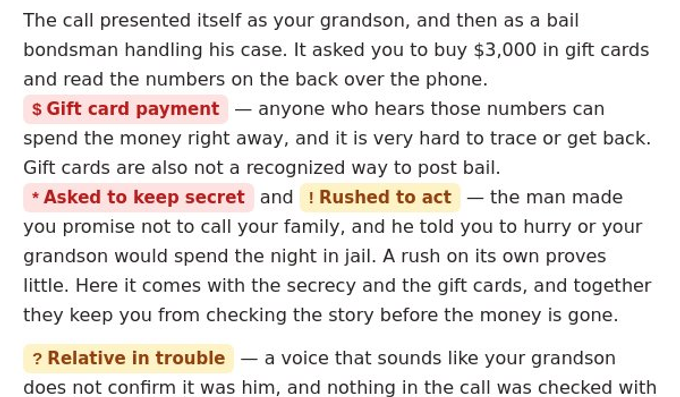
A user described a late-night call from a voice that sounded like their grandchild, crying and saying they had been in a car accident and arrested, followed by a “bail bondsman” who asked for $3,000 in gift cards, to be read out over the phone, and asked that no one else in the family be told.
The request for secrecy, the demand for gift cards read aloud, and the pressure to act before verifying with anyone else are the three classic markers of this scam. The grandchild in question was safe at home the entire time and had never made the call.
Verify through official channels
- Report the call to the US Federal Trade Commission at reportfraud.ftc.gov.
- Report it to the FBI Internet Crime Complaint Center at ic3.gov, especially if money was sent.
- If money has already been sent by wire transfer or gift card, contact the transfer company or retailer immediately. Some transactions can still be intercepted if reported fast enough.
- Contact your local police non-emergency line to file a report.